ISS tonight
Can I see the ISS tonight?
Calculating…
Modelled on the Japan Weather Association’s Kibo pass map. Each label gives the local time the pass first appears in that city, with the direction at its highest point in brackets. Coastlines: GSI Japan for Japan, Natural Earth elsewhere.
Times are when the ISS first becomes visible; directions are where it appears and where it fades out. Elevation is its highest point in the sky: 90° is straight overhead, and 10° is low enough to be hidden by buildings or hills. The calculation is simplified, so times can be a few minutes off.
Why
Why only at certain times?
The ISS has no light of its own. It shines by reflecting sunlight. So two things have to be true at the same time for you to see it.
First, the ISS must be in sunlight. It flies about 400 km up, so it stays sunlit for a while after the ground below has gone dark.
Second, the sky where you are must be dark. Against a bright sky, the reflected light is lost.
Both are true only for an hour or two after sunset and an hour or two before sunrise. In the middle of the night the ISS is in the Earth’s shadow, so you won’t see it even if it passes right overhead. This page lists only the times that meet those conditions: at least 10° above the horizon, the ISS in sunlight, and the Sun at least 6° below your horizon.
What it looks like
A bright, steady star glides silently across the sky over a few minutes. Unlike a plane, it does not blink. At its brightest it rivals Venus and is easy to pick out even under city lights. It may suddenly fade partway across — that is the moment it enters the Earth’s shadow.
How to spot it
Head outside two or three minutes early and take in a wide stretch of sky in the direction listed. You don’t need binoculars — they narrow your view and make it harder to find. Passes higher than 30° are easier to follow without buildings in the way.
App
Upcoming passes and alerts
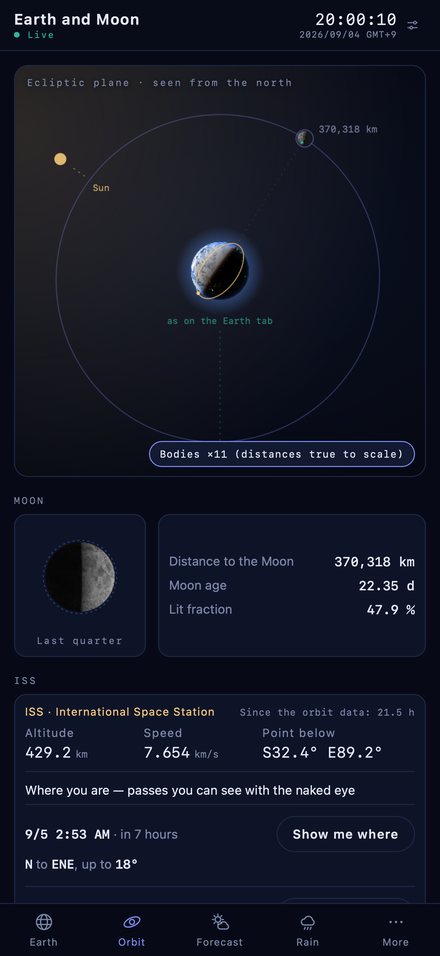
This page answers for the next three passes. To see the ground track on the globe, look further ahead, or check the clouds and rain at the same time, the app is the better fit.
Get it on the App Store for iPhone and iPad, or open the browser version right away. Both are free, with no ads.